
The Job Title Circus That Got Out of Hand
This post was originally written in Sep 2025 (here), and I am cross-posting here since I had a conversation just yesterday which made it obvious that this transformation is accelerating.
I’ve been watching this mess unfold for years now.
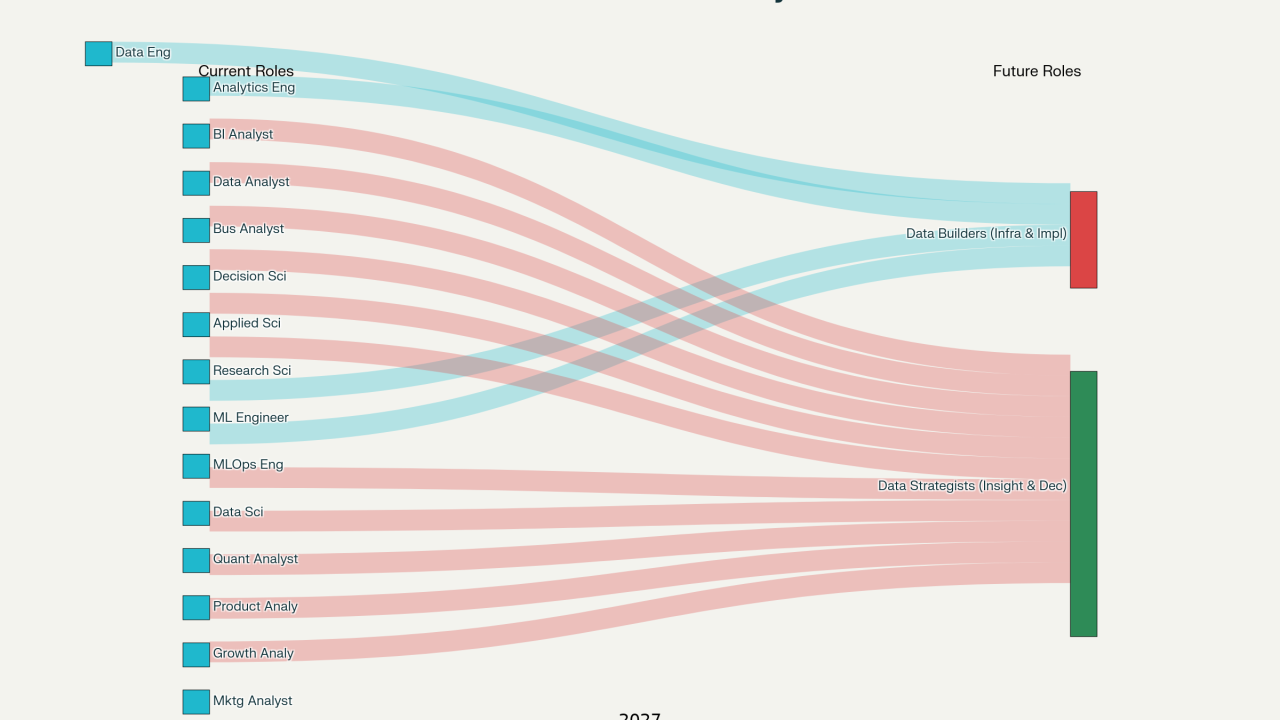
Data Engineer, Analytics Engineer, Business Intelligence Developer, Data Analyst, Business Intelligence Analyst, Decision Scientist, Applied Scientist, Research Scientist, ML Engineer, MLOps Engineer, Data Scientist, Quantitative Analyst, Product Analyst, Growth Analyst, Marketing Analyst...
Stop.
We’ve created a job title circus that serves nobody. Not companies. Not professionals. Not the industry.
And it’s about to collapse.
I’m calling it now: By 2027, this chaos consolidates into 2 clear job families. The companies that figure this out first will dominate. The professionals who adapt early will thrive. Everyone else is going to get left behind in the confusion.
Why My LinkedIn Comment Exploded (And What It Tells Us)
last week, I commented that we need to go from ~15 job families to 2 in data. That comment exploded (in a good way).
Why? Because everyone knows it’s true, but nobody wants to say it out loud.
Here’s what’s really happening:
Companies are drowning. They post jobs for “Senior Data Analysts with ML experience and Python skills who can build data pipelines and present to executives.” That’s not a data analyst. That’s three different roles mashed together because nobody knows how to define what they actually need.
Professionals are stuck in title limbo. I see resumes with 5 different job titles for the same work. “Data Scientist” at one company equals “Business Analyst” at another. It’s complete madness.
Career paths are broken. How do you grow from “Analyst” to “Principal Data Scientist”? Nobody knows because we made up half these roles in the last 5 years.
Salaries are all over the place. Same work, different titles, $50K gaps. The market can’t price what it can’t define.
The chaos is unsustainable. And market forces are already fixing it.
The AI Reality Check
Everyone’s debating whether AI will replace data analysts. Wrong question.
The right question: Which data roles add unique human value when AI handles the routine stuff?
Here’s what I’ve learned watching AI transform workflows at multiple companies:
What AI eliminated:
Manual data cleaning and prep
Basic visualization creation
Standard reporting and dashboards
Simple statistical analysis
Code debugging and optimization
What AI amplified:
Strategic problem solving with business context
Complex decision maker management and communication
Creative experimentation and hypothesis generation
Systems thinking and architectural decisions
Ethical AI governance and bias detection
The result? Most data roles are converging into two categories based on what humans uniquely provide.
The 2 Job Families That Will Survive
After analyzing hundreds of job descriptions and actual work responsibilities, the consolidation is obvious:
Data Builders 🔧
Implementation & Data platform Specialists
What they do:
Build and maintain data systems that work at scale
Implement ML models and automation workflows
Ensure data quality, security, and performance
Create tools that enable everyone else to succeed, including AI
Current job titles merging here: Data Engineer, Analytics Engineer, MLOps Engineer, Platform Engineer
Why they matter: These are the people who make data work. They’re the builders.
Data Strategists 🧠
The Insight and Decision Specialists
What they do:
Solve complex business problems using data and AI
Drive strategic decisions through analysis and experimentation
Translate between technical capabilities and business needs
Design experiments that move key metrics
Current job titles merging here: Data Scientist, Business Analyst, Product Analyst, Decision Scientist, Research Scientist
Why they matter: These are the people who turn data into business impact. They’re the thinkers.
Why This Consolidation Is Inevitable
Follow the money.
Companies are tired of managing 15 different data roles with overlapping responsibilities. They want clear hiring criteria, predictable career paths, efficient team structures, and measurable impact.
The consolidation isn’t coming. It’s already here.
Smart companies are quietly restructuring their data teams around these two core functions. The job boards just haven’t caught up yet.
I’m seeing startups hire “Data Engineers” and “Data Scientists” with genuinely distinct responsibilities. Tech companies organize around “Data Platform” and “Data Science” teams with clear interfaces. Traditional enterprises finally invest in both infrastructure and strategy capabilities separately.
What This Means for Your Career Right Now
If you’re currently infrastructure focused:
Double down on systems thinking and architecture
Master AI/ML deployment and monitoring
Focus on automation and scalability
Understand business impact of technical decisions
If you’re currently strategy focused:
Develop deeper business and industry knowledge
Master experimental design and causal inference
Become exceptional at communication and influence
Learn to leverage AI tools for analysis
If you’re somewhere in between:
Pick a side as an IC. The generalist “data analyst who does everything” role is disappearing fastest.
Learn both as a data leader.
The Uncomfortable Truth
Most data professionals cling to outdated role definitions because change is scary.
But here’s the thing about market consolidation: You can be part of it, or you can be disrupted by it.
The professionals who recognize this shift early will have their pick of opportunities. The ones who keep debating whether they’re a “Senior Business Intelligence Analyst” or a “Principal Marketing Data Scientist” will get left behind.
What Happens Next
2025: Early adopters start restructuring teams
2026: Consulting firms publish best practices (catching up to reality)
2027: The consolidation becomes industry standard
By 2030: We’ll look back at our current job title chaos like we look back at having 47 different types of “webmaster” in the late 90s.
The Bottom Line
This consolidation isn’t a prediction. It’s already happening.
The question isn’t whether this will occur. The question is whether you’ll adapt proactively or get dragged along reactively.
The future belongs to data professionals who understand that impact matters more than job titles.
Impact comes from doing one of two things exceptionally well: Building data systems that scale, or using data to drive business results.
Everything else is noise.
Originally written in Sep 2025 on Paras’s linkedin newsletter.
Oh man, I am so torn on this. On the one hand I agree AI is both merging and flattening roles. On the other I don’t think we’ll eliminate specialisations - I think they’ll still exist, but that they’ll be carved along different lines (especially domain/problem space). eg some builders will focus on the platform, others on specific value streams. You could bounce between the two, but the rest may be that your career capital isn’t as accumulative (ie you’re partially “starting over” even if some stuff stays transferable) - which is similar to bouncing between eg DS and DE (but less extreme, for the reasons you have presented re:AI’s impact on the work)
I also think there’s a lane between the strategist and the builder we’ve been really bad at identifying both pre-AI and now: Change management. If you had to slot it in your 2 I’m guessing it would go into Strategist, but it’s an example of a specialisation I think makes sense to treat as something separate to eg “how do we land this insight with our stakeholders” or “how do we identify and prioritise new problems for the builder team to solve”