
Most companies are not behind because they lack artificial intelligence tools.
They are behind because their learning does not compound.
A data analyst asks ChatGPT for help writing a database query.
A product manager asks Claude to summarize a dashboard.
A data lead uses artificial intelligence to clean up metric docs.
Useful.
But the company still starts over every time someone asks:
“Why did this number change?”
That is the gap.
An AI-native data team is not a team where everyone uses chatbots.
It is a team where every trusted answer makes the next answer faster, safer, and easier to reuse.
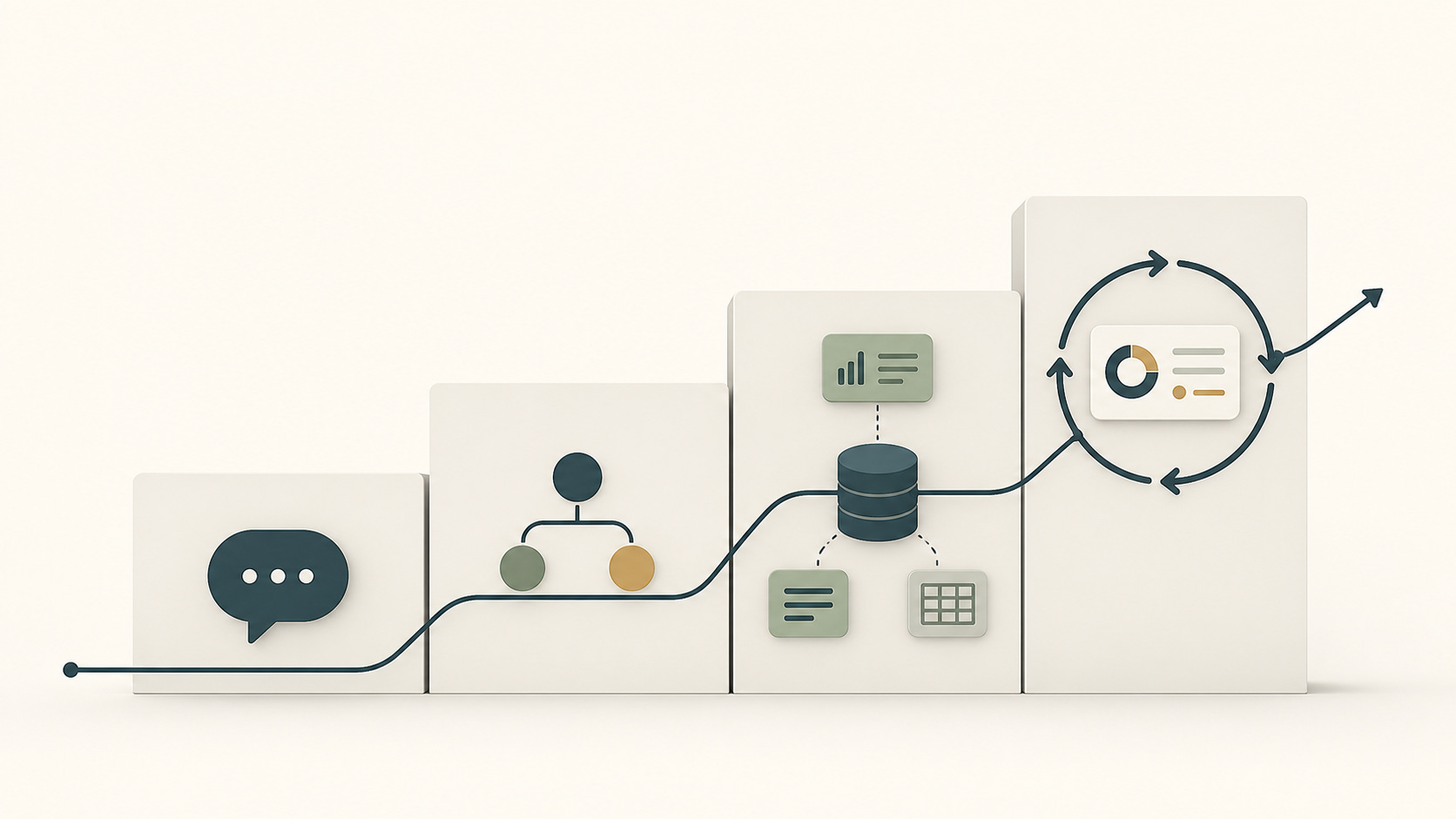
There are four levels.
Level 1: one person gets faster
This is where most teams start.
People use artificial intelligence for:
writing database queries
summarizing dashboards
cleaning up metric definitions
drafting analysis
checking logic before a meeting
This is worth doing.
But the knowledge is private.
It lives in one chat, one notebook, one analyst’s head, or one meeting thread that disappears after the decision.
The test is simple:
Can someone else run the same task next week and get the same standard of answer?
If not, the team is still at level 1.
Level 2: repeated work becomes an agent
At level 2, the team stops treating artificial intelligence like a helper for random tasks.
It gives agents repeatable jobs.
A query review agent checks whether the logic makes sense.
A metric definition agent checks the owner, grain, filters, and caveats.
A dashboard quality agent checks whether the chart matches the trusted source.
An experiment readout agent checks whether the conclusion follows from the setup and the data.
This is the move from prompt to workflow.
The agent has a job.
It has inputs.
It has tools.
It has a review standard.
This is where teams start to feel fast.
It is also where they start to create new problems.
Because a fast agent with weak context can produce confident answers that disagree with each other.
One agent uses the product team’s definition of activation.
Another uses the sales team’s definition.
One checks the dashboard.
Another checks the raw database table.
One remembers the caveat.
Another misses it.
Now you have more output, but less trust.
That is not leverage.
That is cleanup work with better branding.
Level 3: the company stops re-teaching the same facts
At level 3, agents stop working from isolated prompts.
They pull from shared company context:
approved metric definitions
trusted data sources
dashboard lineage
business rules
known caveats
owner notes
prior accepted answers
This is where artificial intelligence analytics starts to compound.
An analyst clarifies a metric once. Future agents can reuse it.
A data owner approves a caveat once. It stops getting lost in chat.
A recurring business question gets answered with proof once. The next answer starts from that approved path instead of rediscovering the logic.
This layer is not glamorous.
It is also the difference between “AI helped me” and “the company learned.”
Without it, you do not have an AI-native data team.
You have faster guessing.
Level 4: answers improve the system
Level 4 is the real shift.
The answer is no longer the finish line.
A business question creates an answer.
The answer includes evidence.
A human reviews or corrects it.
The correction updates the definition, dashboard, checklist, or owner note.
The next agent starts from the improved version.
That is a closed loop.
The data team stops acting like a request queue.
It becomes decision infrastructure.
Not because it has more dashboards.
Because the company gets better at asking and answering the same important questions.
The mature system tracks things like:
Was the right definition used?
Was the right source checked?
Was the evidence strong enough?
Was the answer accepted, corrected, saved, or reused?
Did the correction improve the next answer?
Did the system ask for clarification instead of guessing?
That is the new scoreboard.
Not how many charts were viewed.
How many trusted answers were created.
How many were corrected before they caused damage.
How many became reusable.
How many repeated questions stopped interrupting the data team.
The hidden failure
Many companies will think they are at level 3 because they have a metric catalog, a semantic layer, or a folder full of documentation.
That is not enough.
A definition sitting in a doc is not company memory.
A dashboard nobody trusts is not a source of truth.
A chat answer that solved the problem once but never became reusable is not leverage.
It is residue.
The compounding asset is the reviewed answer path.
For every recurring question, the system should know:
what the metric means
which source to trust
which filters matter
which caveats change the answer
who owns the definition
what evidence makes the answer reusable
when the agent should ask a clarifying question
when the agent should send the answer to a human for review
when the agent should refuse to answer
That is how a data team scales without turning every AI answer into another review burden.
The 30-day move
Do not start with the whole data warehouse.
Start with one recurring question.
Something like:
“Why did self-serve conversion drop last week?”
Then build the loop around it.
Week 1: write the exact question, the metric, the decision it supports, and what would make the answer wrong.
Week 2: build one narrow agent with a clear job and review standard.
Week 3: create the context packet: definition, grain, source, owner, caveats, and examples of accepted answers.
Week 4: close the loop. Save the evidence. Save the answer path. Turn corrections into future checks. Update the docs and dashboards.
That is enough to show whether the company is serious.
The test is not:
“How many agents do we have?”
The test is:
Can the business ask better questions, get trusted answers faster, and make the next answer better because of what it learned this time?
If yes, artificial intelligence is compounding.
If no, it is just a prettier dashboard help desk.
What level is your company at right now?
And what is the biggest blocker between where you are and level 4?