
Every few weeks, someone says semantic models are dead.
The argument usually sounds something like this: AI can query raw data, figure out joins, and answer questions in plain English, so why spend time modeling metrics at all?
I get why that sounds appealing.
But at least from where I sit right now, it is the wrong conclusion.
AI is absolutely making analytics faster. What it is not doing is magically creating shared business meaning.
That is still the hard part.
A human analyst can look at messy data and bring judgment to it. They know which revenue definition leadership actually uses. They know which table is technically available but operationally wrong. They know which segment should be excluded, which timezone matters, and which “right” answer will still cause confusion in the room.
AI does not automatically inherit that judgment.
So if you put AI on top of raw tables, fragmented dashboards, and inconsistent KPI logic, you do not eliminate confusion. You scale it.
That is why I do not think semantic models are dead.
If anything, AI makes them more important.
Because the bottleneck is no longer query writing. The bottleneck is trust.
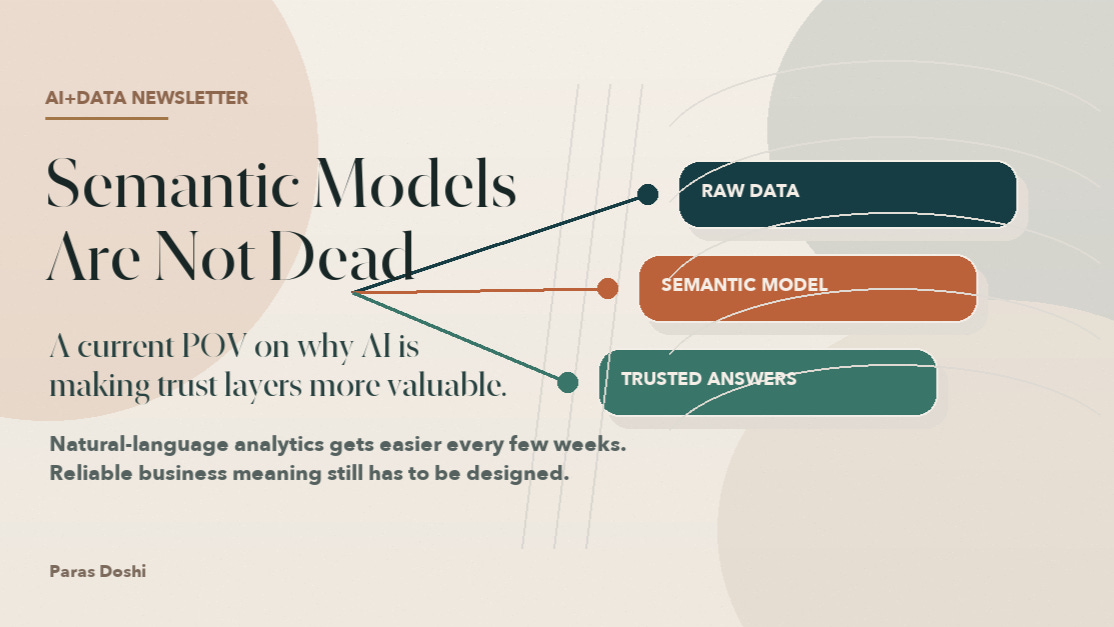
A semantic model is not just BI plumbing. It is the layer that tells both humans and machines what a metric officially means. It creates one governed definition, reusable logic, and a more stable path between a business question and a trustworthy answer.
Without that layer, AI can still answer quickly. It just cannot answer consistently.
And in analytics, inconsistency is what kills trust.
The real risk is not only hallucination. It is metric drift.
One prompt pulls from one source. Another prompt pulls from another. A dashboard says one thing. A spreadsheet says another. An executive asks a simple question, and suddenly the meeting turns into a debate about definitions instead of a decision about the business.
That is not an AI problem in isolation.
That is a definition problem.
Semantic models help reduce that ambiguity. They give the business, the data team, and now the AI layer a shared contract for what counts.
To be clear, I do not think a semantic model solves everything.
You still need business context, caveats, approved answer paths, and operating judgment around how metrics should be used. But that is exactly the point: semantic models are not the whole solution, yet they are still a foundational part of the solution.
So my current POV is simple: AI makes natural-language analytics easier. It does not make semantic discipline optional.
The teams that win will not be the ones with the cleverest prompts. They will be the ones with the clearest definitions, the strongest trust layer, and the discipline to keep AI grounded in governed business meaning.
POV is mine; AI helped shape the final draft.